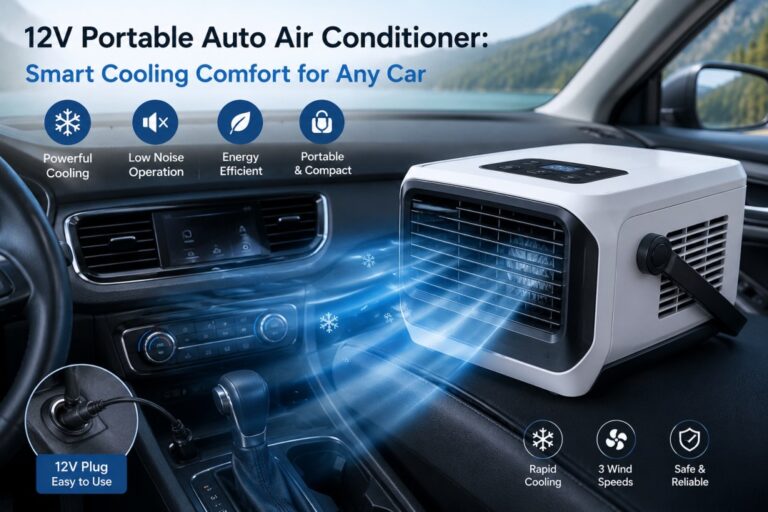
The Complete Guide to a 12 Volt Air Conditioner: Off-Grid Cooling for Your Camper or Van
If you reside in a van, camper, or off-grid mobile setup and require cool air without using traditional shore power, then a 12-volt air conditioner is the best upgrade to have. In this article,...

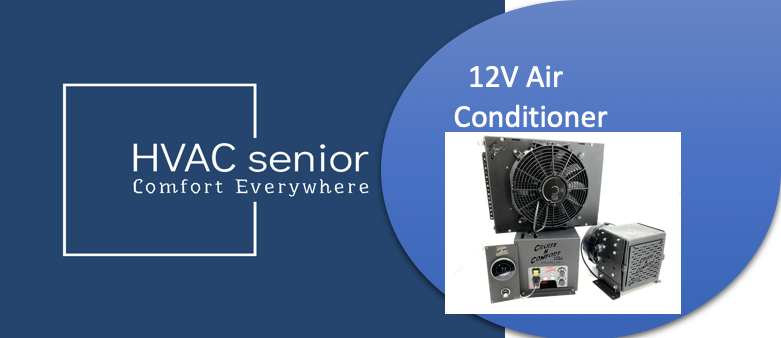
If you reside in a van, camper, or off-grid mobile setup and require cool air without using traditional shore power, then a 12-volt air conditioner is the best upgrade to have. In this article, we’ll cover what they are, how they work, what to look for when buying, how to install and operate them efficiently, and why they are essential for mobile comfort.
What is a 12V Air Conditioner?
A 12 volt (12V DC) air conditioner is a cooler that works directly from a 12-volt power source rather than normal household power. This makes it perfect for use in campers, vans, RVs, boats, or trucks. Because it works on DC power, it may be powered directly from an auxiliary battery of a vehicle or a solar system without the use of an inverter.
All models are small and energy-saving, perfect for tiny mobile interior spaces. They are built to endure the vibration, dust, and temperature fluctuations of off-grid travel, so they are perfectly suited for anyone who lives or camps in a vehicle.
Why Use a 12 Volt Air Conditioner?
1. Ideal for Off-Grid Living
Unlike other AC units, the 12 V system can operate completely on batteries and solar panels. You’re not obligated to be connected to a campsite hookup or generator, allowing you to camp wherever you want without discomfort.
2. Simple Integration
Since it’s powered by DC, it doesn’t need complicated wiring or a big inverter system. That means fewer parts, less power lost, and easier installation in general.
3. Energy Efficiency
New 12V air conditioners use advanced compressors and variable-speed fans to minimize energy consumption while delivering strong cooling capability. They are designed to work optimally even under hot conditions.
4. Lightweight & Compact
A 12-volt system weighs much less and is more compact than a regular AC, making it ideal for camper vans or cab trucks where there isn’t that much space. The majority of them fit snugly over the roof or into regular vent openings.
5. Quiet Operation
Because these units are indoor applications, companies apply low noise levels during their design — a necessity for sleeping or reclining in your camper.
The Key Things to Consider when Buying a 12 Volt Air Conditioner
Choosing the right 12 V air conditioner keeps you cool without draining your power system.
Cooling Capacity (BTU / kW)
Cooling capacity is either in kilowatts or BTUs. Small trucks or truck cabs will need an estimated 5,000–7,000 BTU, while large RVs might need 9,000 BTU or more. Always refer to matching the AC cooling capacity with your car size, insulations, and climate requirements.
Voltage & Power Draw
While it’s a 12 V appliance, monitor its amps current usage closely. Most take between 40–80 amps, which will strain your battery bank. Make sure your wiring and fuses can handle that safely.
Battery & Solar Compatibility
If it’s solar-powered, calculate your daily energy load. Include the power draw of your AC along with other loads, and ensure that your solar array and battery capacity are adequate for meeting the same. Lithium batteries (LiFePO4) are usually best suited for this use owing to their efficiency and deep discharge feature.
Installation Type & Size
The majority of 12 V air conditioners are rooftop or split systems. Rooftop models will fit typical RV openings, but split models have an internal and external section combined with refrigerant lines. Check the strength, size, and clearance of your roof before buying.
Noise Level
Models that are quiet are best for sleeping. Pick models rated under 50 dB for night use.
Build Quality & Maintenance
Since these units are installed in the outdoors or mobile setting, ensure the design is easy to maintain, dust-free, and durable. Ensure filters and vents are easy to access for maintenance.
Also read: 120V to 12V Converter
How to Install a 12 Volt Air Conditioner in a Camper or Van
Step 1: Evaluate Your Power System
Prior to installation, ensure your power system is capable of sustaining the AC’s load. Employ heavy gauge wire to reduce voltage drop, and include fuses or circuit breakers for protection.
A good guideline:
• take a minimum of 300–400 Ah lithium battery capacity for full-time operation.
• include 400–800 watts of solar panels to charge your system cost-effectively.
Step 2: Plan the Mounting Location
Decide where to mount the AC — typically the roof or into an existing vent opening. Provide adequate clearance for ventilation and airflow.
Step 3: Mount the Unit
Cut or use a pre-cut hole to install the unit. Seal leaks with sealant or gaskets. The AC must be supported by the structure (usually 25–35 kg).
Step 4: Install Electrical Wiring
Use proper connectors and heavy-duty wire directly from the battery bank. Avoid having long runs to keep voltage loss at a minimum. Include a low-voltage cutoff switch to avoid over-discharge of the battery.
Step 5: Ventilation and Airflow
Allow adequate space on the condenser and evaporator for efficiency of heat. Keep vents unobstructed and avoid blocking airflow from roof racks or cargo.
Step 6: Test the System
Following installation, power the unit from a fully charged battery and measure startup and operation voltage drop. Verify that it cools well and is quiet to run.
Maximum Efficiency Hints
•Pre-cool camper before peak sun hour.
•Park in shade to avoid interior heat gain.
•Use reflective window and roof covers.
•Run the AC on ECO or Sleep mode at night to save energy.
•Clean filters regularly to maintain performance.
•Monitor your battery voltage — never let it fall below safe levels.
•Fit fans as well as the added AC to circulate air properly.
Avoid These Avoidable Blunders
•Underestimating power requirements — your AC won’t cool properly if there’s too little battery voltage.
•Assuming insulation will always do the job — an insufficiently insulated van loses cool air quickly, with the AC working constantly.
•Bad wiring — thin wires or extended runs can cause overheating and voltage loss.
• Bypassing maintenance — clogged vents and dirty filters reduce cooling performance.
• Using a too-small battery bank — short runtimes and deep battery discharge shorten battery life.
Is a 12 Volt Air Conditioner Worth It?
For the majority of full-time van lifers and off-grid travelers, absolutely. A 12 V air conditioner provides you with flexibility and comfort hard to match with other systems. It allows you to cool anywhere, any time — without campground hookups.
However, if you boondock or live in temperate zones, you’ll likely be able to manage with a portable fan or evaporative cooler. The initial investment in a 12 V AC system (unit + battery + solar) might be too high, but the comfort and independence you’ll enjoy make it well worth it.
Quick Buying Checklist
Before you purchase your 12 V air conditioner, be sure to:
✅ Cool size cooling capacity to your camper and insulation
✅ Check amp draw and ensure your system can cope with it
✅ Ensure compatibility with solar or battery installation
✅ Ensure mounting dimensions and weight compliance
✅ Look for noise level ratings below 50 dB
✅ Choose a good brand with good support service
✅ Look at ventilation and maintenance planning
Final Thoughts
A 12 volt air conditioner is the cooling choice for anyone who resides or travels in a van, RV, or camper. With good installation, it keeps your environment at comfortable temperatures even in the midst of the hottest summer — without tying you to electrical hookups.
Pay attention to pairing capacity, battery capacity, and solar power to your cooling demands. After accurate installation, your 12 V air conditioner will provide quiet, efficient, and reliable cooling wherever your travels take you.